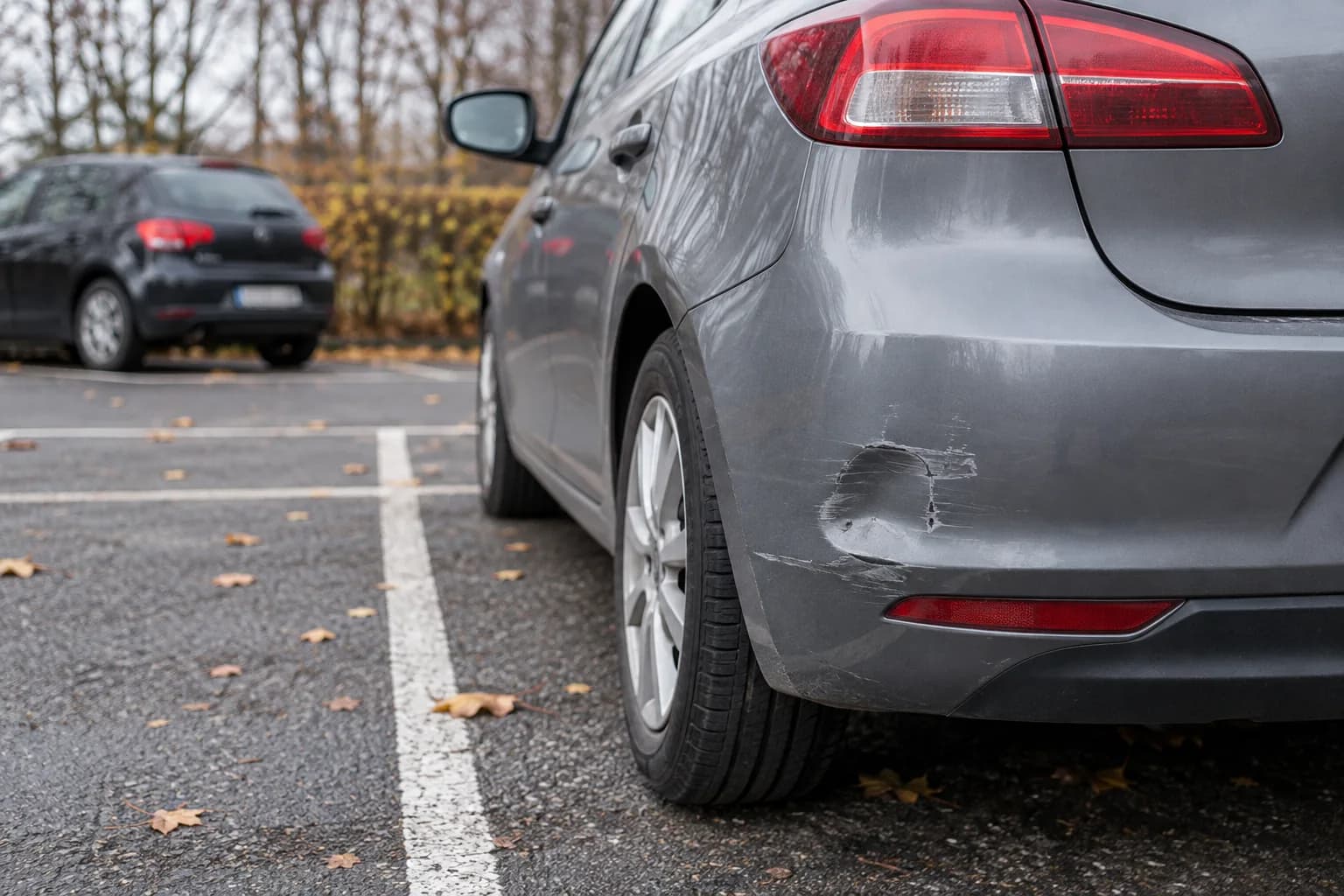
1. What should you record when you find the damage?
First check that the location is safe. Call 112 for injuries or immediate danger. Do not drive if you have doubts about the car's condition.
Record separately when you parked, when the car was last known to be undamaged and when you found the damage. Do not turn that time window into an invented exact collision time. Photograph the location, the whole car and the affected area. Keep original files, witnesses' contact details and any note left by the other driver.
Ask the operator or security staff to preserve CCTV covering the place and time window. Note who you spoke to. Do not assume that a camera was working or that footage will be handed directly to you. Tell the Police about possible cameras and witnesses when reporting the incident.
2. Which situation matches yours?
In Poland, OC is compulsory motor third-party liability insurance. AC is voluntary cover for your own vehicle; OWU means the general policy terms. Calling an incident “parking damage” does not establish who pays.
| Situation | Evidence | Next step | What to check |
|---|---|---|---|
| Known driver and vehicle with OC | Participant details, incident account and photos | Report to the other vehicle's OC insurer | Cover on the incident date and liability |
| Identified vehicle without OC | Vehicle identification and evidence of the incident | Ask an OC insurer about submitting a UFG claim | Statutory conditions and any AC cover of your own |
| Unknown driver; only the car is damaged | Location, time window, photos, witnesses or cameras | Report to the Police and check your own AC | AC scope; a report alone does not establish entitlement from UFG |
| Suspected deliberate scratching | Marks and circumstances without guessing who did it | Notify the Police and contact your AC insurer | Whether the event is covered and which duties apply |
3. Known driver: record the incident and check OC
Where nobody is injured, both parties agree on what happened and responsibility, and there is no suspicion of a crime, a written collision statement can be used. Contact the Police if responsibility is disputed, details are refused or intoxication is suspected. Do not sign an account you disagree with.
Organise the date, location, driver and vehicle details, manoeuvre, damage and participants' signatures in the statement. A registration number or VIN can be used to check the OC insurer for a chosen date through UFG. That search does not determine fault or the compensation amount.
4. Unknown driver: the important UFG limit
An unidentified driver is different from an uninsured vehicle. Under Article 98(1)(2), property damage involving an unidentified liable party requires a participant's death or impairment of bodily function or a health disorder lasting over 14 days, confirmed by the appropriate medical specialist. The vehicle payment is then reduced by the equivalent of EUR 300. A scratch with no personal injury does not meet those conditions.
An identified vehicle without compulsory OC falls under a different provision, Article 98(1)(3). UFG claims are submitted through an insurer providing the relevant compulsory insurance (Article 108). If you have voluntary cover, Article 106 also matters. These rules do not guarantee payment for an individual claim.
5. Another vehicle or vandalism?
A deliberate key scratch and contact with another vehicle call for different accounts of the circumstances. Do not classify the incident from the shape of a scratch alone. Describe what you observed and separate assumptions from evidence. Motor OC is not general cover for every act of vandalism.
For AC, check cover, exclusions, excess, reporting and inspection duties. One product example is PZU Auto UZ/5/2026: section 50 requires Police notification where a crime is suspected and sets a separate deadline for informing PZU. These are that product's terms; check the OWU version attached to your contract.
6. What should you agree before authorising repair?
Give the repair shop a short incident account, photos and a claim reference if issued. Agree a secure channel for documents. Ask separately about assessing damage, authorising work and payment: each requires its own agreement.
- Who will document the damage before repair, and how?
- Does the insurer need an inspection or additional photographs?
- Which work are you authorising, and who pays for items not agreed with the insurer?
- How will any additional damage be recorded and agreed?
- Do you have confirmation of the arrangements and copies of the documents sent?
Is a note under the wiper enough?
Keep it, then complete the details and incident account. The Polish Financial Ombudsman advises the driver who caused damage to actively seek the owner, for example through shop security: a note can disappear. A phone number alone is no substitute for a clear record.
Where can you find the next step?
Information checked on 15 October 2026. Use the guides below to prepare your records. You can discuss the available repair and claim-handling scope with Glossline without assuming the insurer's decision.
Scope of this guide
This is general information, not a decision on a specific claim. The right next step depends on the documents, damage and insurer’s position.
Sources and further reading
These materials cover safety and insurance claim handling in Poland. They do not confirm the outcome of an individual claim or the scope of Glossline services. The original source materials are in Polish.
- Polish Compulsory Insurance Act: Articles 34–35, 98, 106 and 108 (consolidation dated 28 July 2026)
- Radomsko Police: a parking collision (archived guidance)
- UFG: check vehicle liability insurance on the incident date
- PZU Auto: policy terms UZ/5/2026 of 20 January 2026, sections 3, 8 and 50
- Polish Financial Ombudsman: parking collisions and leaving the scene (4 June 2020)