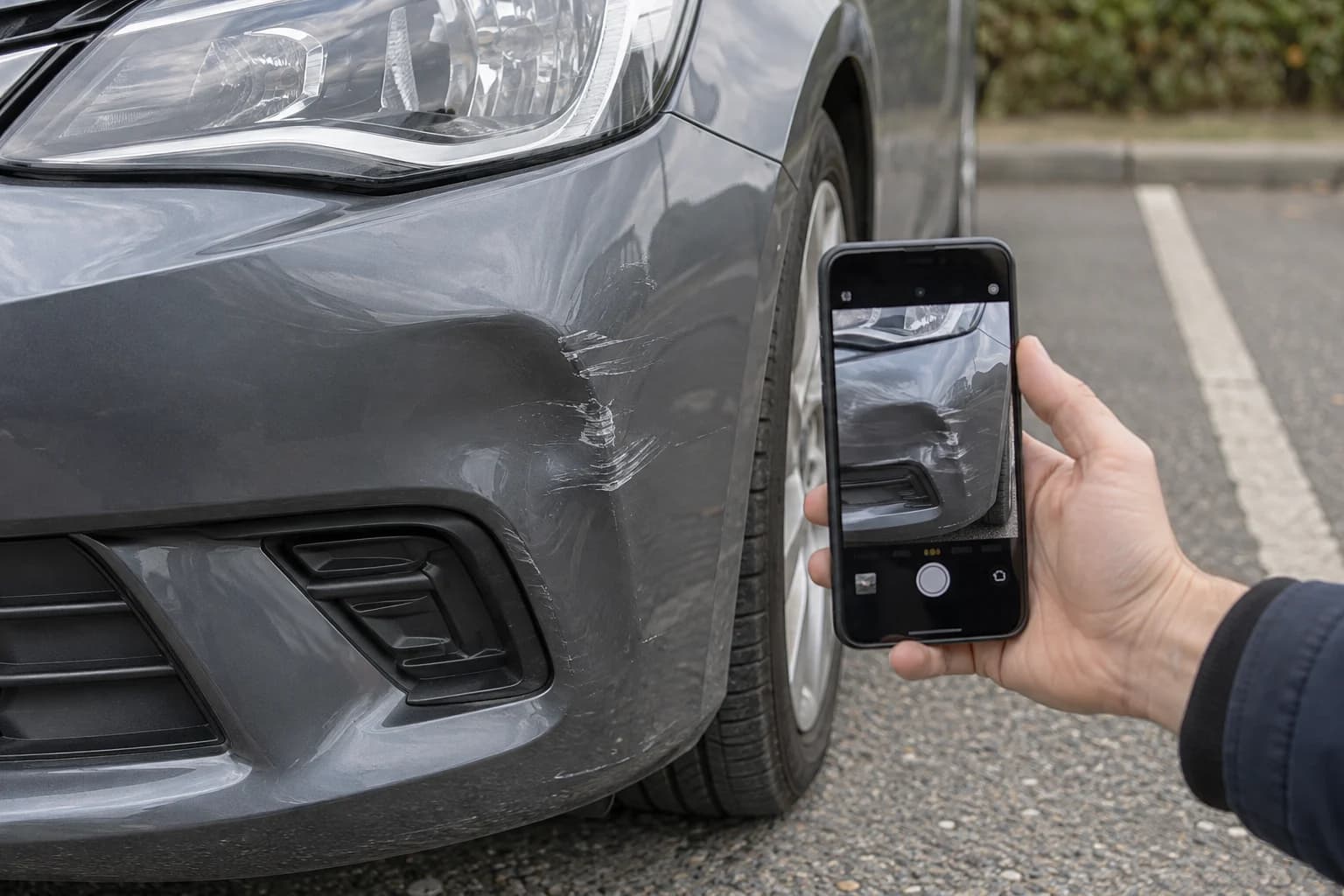
1. A safe position comes before the camera
Take photographs only when you can stand safely beside the car. Do not step into live traffic, crawl underneath or touch sharp edges. If the car is in a dangerous position, deal with assistance and safety first. Missing photographs can be supplied later.
Do not start or move the car just to improve the view if you suspect wheel, steering or brake damage or a leak. Note why a particular photograph could not be taken. A missing image is not a reason to take a risk.
2. Which views make damage easier to understand?
Start with an overview, then show the complete affected panel and finish with close-ups. Keep a recognisable reference point in the detail shot: a lamp, door edge, wheel arch or panel joint. A large image of a scratch with no context may not show where it is.
| View | What should be visible? | What to avoid |
|---|---|---|
| Whole car from the corners | Vehicle outline, front and rear, and affected side | An isolated fragment that does not identify the car |
| Complete affected panel | The area from edge to edge and neighbouring parts | Cropping away the position of the damage |
| Close-up | A scratch, crack or deformation in focus | Blur or a finger covering the mark |
| A second angled view | Surface shape and the extent of a deformation | A reflection hiding the entire mark |
| Odometer, if requested | Readable mileage and visible messages | Starting an unsafe car only to take a photo |
| VIN and documents when requested | The details the recipient needs, sent securely | Publishing documents or identifiers online |
3. Focus and light: check before sending
A phone is usually enough to produce clear photographs. Clean the lens, tap the damaged area on the screen and zoom into the saved image to check it. Judge the actual file rather than the small camera preview.
If glare obscures the mark, change the camera position. Avoid heavy digital zoom: move closer where safe and keep an additional wider view. For a dent, two different angles of the same area can be clearer than several almost identical close-ups.
- The damage is sharp and not lost in shadow.
- The affected panel can be recognised in the close-up.
- There is at least one wider view of the same area.
- The file has not been replaced by a screenshot or altered with a filter.
4. Check your own insurer's requirements
PZU's vehicle guide shows diagonal views, an overview of the damage and detail shots. Its glass instructions include additional views depending on the equipment. These are PZU instructions, not a shared standard for every insurer.
Warta's guide lists the affected area, close-ups, mileage, VIN and both sides of the registration document, among other views. Follow its instructions and use the agreed channel for documents.
For quick assessment of specified damage types, Allianz lists four corner views, damage details, the odometer and registration document, and JPG, JPEG and PNG formats. Check the current requirements for your own claim; this list is not universal.
This guide concerns Poland. OC is compulsory motor third-party liability cover, AC is voluntary cover for your own vehicle and OWU means the general policy terms. Agree documentation for your case with the organisation handling it.
5. What cannot be assessed from photographs?
A photograph records a visible surface in particular light. It cannot reveal parts behind a bumper, check inaccessible mountings or measure vehicle geometry. It also cannot confirm that the car is safe to drive.
A preliminary repair discussion based on photos is different from an inspection within an insurance claim. Ask whether another view, an on-site inspection or documentation after safe dismantling is needed. The repair price and method should not be decided from the appearance of a scratch on a screen alone.
6. Organise and share the files
Keep originals in a separate folder. Include a short note with the incident date and location, the affected side and the claim reference if one has been issued. Make it clear if the time is only approximate.
You can arrange working copies using names such as 01-whole-car, 02-left-front and 03-close-up. Do not alter the damage marks or use AI to enhance claim evidence. If you send images through a messaging app, check whether the recipient needs original files rather than compressed pictures.
Confirm the recipient's address or app. Registration numbers, VIN and documents may be needed for a specific claim, but should not appear in a public post. For a first repair-shop discussion, ask what material is needed and how to send it securely; do not assume that every channel is available.
Do I need exactly four photographs?
There is no single set for every claim. Four corner views can show the whole vehicle, but they do not replace damage details. Take the photographs your insurer requests and add clear context.
Should I wash the car first?
Record visible marks as you find them first. Do not remove them just to make the photographs look better. If dirt prevents assessment, ask how to supplement the record and keep any photographs taken before cleaning.
What should I read before the next step?
Photographs are part of the record, not a decision to cover repair costs. These guides help you prepare other information and understand why the repair scope may require an inspection.
Scope of this guide
This is general information, not a decision on a specific claim. The right next step depends on the documents, damage and insurer’s position.
Sources and further reading
These materials cover safety and insurance claim handling in Poland. They do not confirm the outcome of an individual claim or the scope of Glossline services. The original source materials are in Polish.