When can you write a statement and when should you call the police?
Make the scene safe first. If someone is injured, may be injured or has died, call 112, give necessary help and leave the vehicles where they are. If nobody is hurt, move your vehicle out of the way as soon as you can do so safely so that it does not create a hazard or block traffic.
Call the police if the drivers give different accounts, disagree about responsibility, or the other driver refuses to share their details or sign the agreed account. Notify the police immediately if you suspect a crime, such as drink-driving. If the other driver leaves, note the registration number if you know it and save any footage and witness details.
What details should you record before signing?
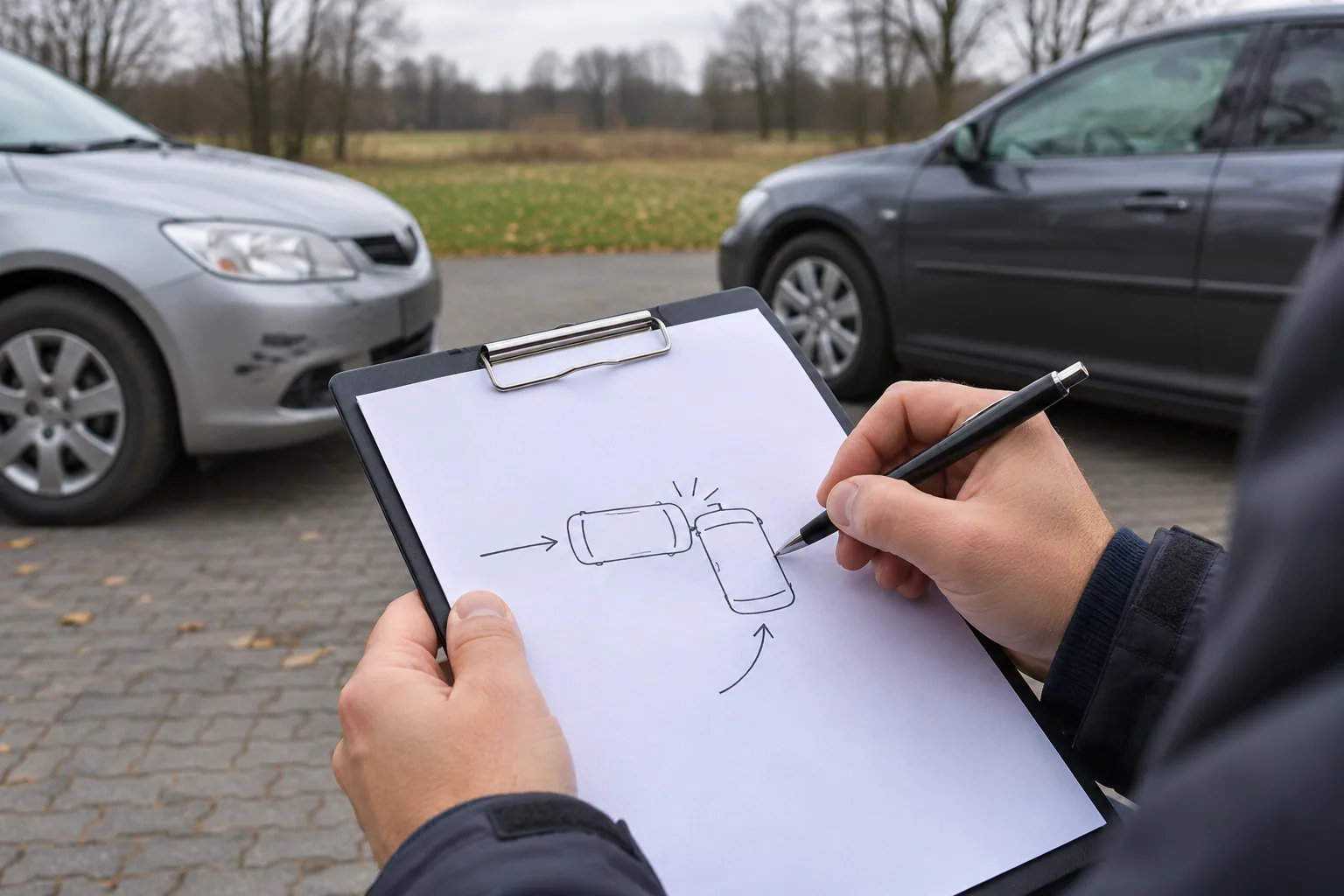
Use a sheet of paper or a joint accident statement form (wspólne oświadczenie o zdarzeniu drogowym). Label the cars A and B and use those labels consistently in the details, description, sketch and damage notes. If the form has tick boxes, check that they match the written account.
- Incident. Give the date, time and exact location, such as the street, junction or road number and kilometre marker.
- People. Record each driver’s full name, address and contact details. If someone else or a company owns or holds the vehicle, record those details separately.
- Vehicles and insurance. Record each car’s make, model, registration number and country of registration. Note the OC insurer and policy number. Use the registration number or VIN to check cover on the collision date with Poland’s Insurance Guarantee Fund (UFG).
- Witnesses and attachments. Record witness contact details if they provide them. List any attached photos or sketch. Save dashcam footage before it is overwritten.
How do you describe the collision? A worked example
This fictional example can be copied onto paper. Replace the bracketed fields with details from the actual incident. It assumes that both drivers agree on what happened and who caused it.
- Time and place. [Date], [time], [town and street], right-hand lane before the junction with [street].
- Vehicle A. [Driver and owner details, make, model, registration, insurer and policy number]. In this example, A was travelling behind B.
- Vehicle B. [Driver and owner details, make, model, registration, insurer and policy number]. B was stopped at a red light.
- What happened. While driving vehicle A, I hit the rear of stationary vehicle B with the front of my car. I confirm that I caused the collision. Driver A writes this confirmation after checking the account.
- Visible damage. A — cracked front bumper. B — dented tailgate and scuffed rear bumper. On the sketch, draw the lane and the traffic light, label A and B, draw an arrow for A and mark the point of contact.
- Confirmation. [Witnesses and attachments, if any]. [Driver A’s signature] and [driver B’s signature]. Both drivers check and sign the same wording.
What should you check before you leave?
| Mistake | How to fix it |
|---|---|
| It is unclear which car moved | Use A and B throughout. Describe where each car was and how it moved before the impact. |
| The policy number belongs to another vehicle | Match the vehicle and policy details. Select the date of the collision when checking with UFG. |
| The statement only says ‘rear damaged’ | Name the part and describe the visible damage. Leave hidden damage for the inspection. |
| The drivers signed before the description was complete | Finish the description and correct both copies before signing. Each driver keeps the same version, including attachments. |
Can you write it by hand, and who needs to sign?
You can write the statement by hand. If the driver who caused the crash makes an individual statement (oświadczenie sprawcy kolizji), that driver signs their account. For a joint statement, both drivers sign the agreed wording. If there is just one signed copy, take a clear photo of every page, including the sketch. Keep the original or a copy to send to the insurer.
Can you make the statement on your phone?
Eligible drivers can use mStłuczka in Poland’s mObywatel app to create a joint digital statement. Check that you can complete the process for both vehicles and save the document. If you choose to file a claim through the app, check for confirmation that it was sent. Saving a statement and filing a claim are separate steps.
Does a signed statement guarantee payment under OC?
The statement is evidence that the insurer considers alongside other material. If the other driver later changes their account, send the version you kept, photos, footage and witness contacts. If police attended, give the police unit and case reference if you have it. The insurer assesses responsibility and the extent of the damage.
What do you do with the signed statement?
Attach it and your photos when reporting the damage to the insurer covering the driver responsible. OC is Poland’s compulsory motor third-party liability insurance. If you are claiming under your own voluntary vehicle cover (AC, or autocasco), check your policy and the general insurance terms (OWU) for reporting requirements. Have your claim reference and damage photos ready when you discuss repairs.
Scope of this guide
This is general information, not a decision on a specific claim. The right next step depends on the documents, damage and insurer’s position.