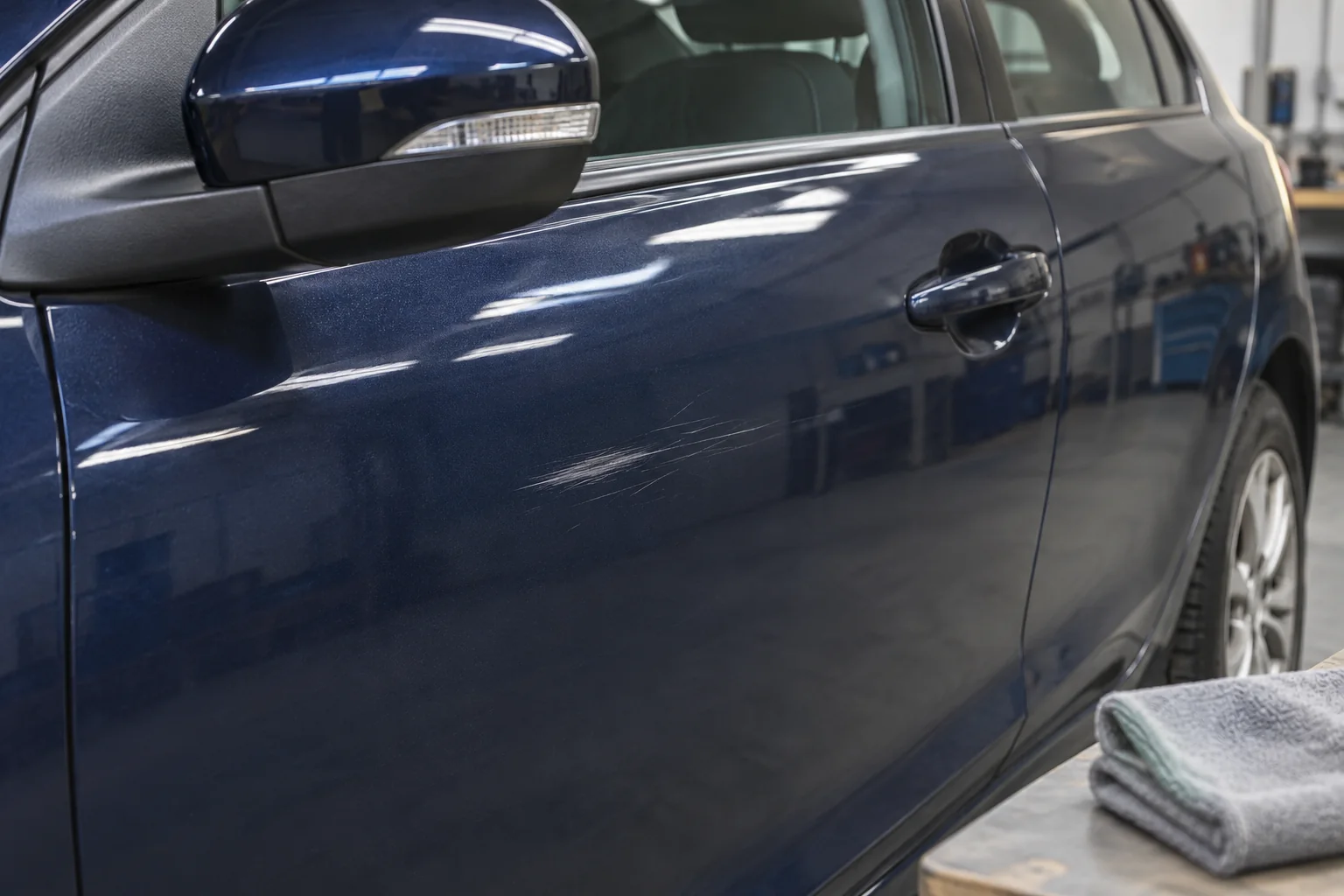
What has actually been scratched?
In a typical basecoat/clearcoat system, preparatory coatings and primer sit below the colour basecoat and clear topcoat. Damage confined to the outer layer differs from a loss reaching the colour, primer or panel material. This is not the layout of every finish: single-stage, multilayer and matt systems also exist. Do not assume the same thickness or repair method for all of them.
A pale scuff may be transferred paint sitting on the surface, damage to the car's own coating, or both. Removing the deposit does not establish that the coating underneath is intact. Record the mark first, then reassess after cleaning appropriate to that finish. The colour of a line alone does not identify a coating layer.
When might polishing be enough?
Abrasive correction levels the surface by removing some material. It can help with fine scratches and marks in clearcoat when the coating condition allows it. It does not add paint. Chasing a deep scratch until it disappears can remove too much coating; an agreed result may be reduced visibility rather than complete removal.
Previous refinishing, edges and measurements with suitable equipment matter before correction. A conventional magnetic or eddy-current gauge on metal measures total coating thickness, not the remaining clearcoat alone. One high reading does not justify aggressive polishing. There is no universally safe pass count or micrometre threshold for every car.
Touch-up, spot repair or panel refinishing?
Touch-up adds material to a small paint loss; it does not automatically provide a perfectly level, invisible finish. Spot repair rebuilds the coating over a limited area. Panel refinishing covers a wider finishing scope. Depth, location, colour, previous coating condition and the procedure for the particular substrate and paint system all affect the choice.
Ask separately about the areas for preparation, basecoat and clearcoat. A small colour area does not necessarily mean a small clearcoat area. For example, PPG's procedure for specified warranty conditions extends clearcoat to a panel edge or natural break. The NEXA P190-8002 data sheet describes a limited fade-out process and advises against it on half panels such as doors. These illustrate system dependence, rather than one rule for every repair.
Compare the mark, possible approach and limitation
Use this table to prepare a discussion. It is not a diagnosis from appearance or approval of a repair method for a particular vehicle.
| Observation | Option to assess | Question to ask |
|---|---|---|
| Transferred colour or a surface deposit | Cleaning and reassessment | Is there coating loss underneath? |
| Fine scratches on a gloss finish | Limited abrasive correction | Can the coating tolerate correction, and what result is realistic? |
| Small area of missing colour | Touch-up or spot repair | What texture and visible repair should I expect? |
| Extensive loss, peeling or corrosion | Coating restoration and substrate assessment | How much preparation and refinishing is needed? |
| Matt, satin or film | Finish-specific procedure | Does the manufacturer allow the proposed method? |
Why are photos and the fingernail test inconclusive?
A photograph shows location and size, but reflections, moisture and dirt change the mark's appearance. It cannot reliably show remaining layer thickness. A nail catching on the mark, or the mark temporarily fading when wet, does not measure depth or establish a safe repair method. Do not scrape the mark to investigate it.
For an initial discussion, prepare a whole-panel view, a close-up with a ruler beside the damage and a second angle on a dry surface. Describe the incident, any known previous refinishing and any protective film. Note dents, cracks or chips. An estimate from photographs may change after inspection; it does not confirm that polishing will be enough.
Matt paint, plastic and film need separate assessment
Do not transfer gloss clearcoat methods to matt or satin finishes. Polishing can change local sheen. For example, Volvo's bulletin for the matt S60 T8 Polestar Engineered rules out removing scratches with wax or polish. Check the instructions for your own finish. A scratch in paint protection film (PPF) or vinyl is also different from a scratch in paint.
Unpainted trim and a painted bumper need different approaches. Plastic does not rust like steel, but polishing cannot remove a crack or deformation. For exposed metal or corrosion, discuss restoring protection rather than aiming only for gloss. Do not use random solvents, toothpaste or sandpaper as a diagnostic test.
What should you agree before authorising work?
Request the scope, expected result, limitations and price in writing before work starts. Separate removal of transferred paint from scratch correction and filling missing coating. Agree what happens if cleaning reveals the need for a different method. Approve additional work and any price change before it is carried out.
- Which damage will be removed and which will only become less visible?
- Have the finish type and previous repairs been assessed?
- Where will the basecoat end, and where will the clearcoat end?
- Does the scope include any dent, corrosion or crack?
- What care instructions will I receive for the system used?
Will insurance pay for scratch repair in Poland?
In Poland, OC is compulsory motor third-party liability insurance; AC is voluntary cover for your own car within the agreed scope. OWU means the general insurance terms and conditions. The appearance of a scratch alone does not determine liability or payment. If making a claim, keep photographs from before any intervention and check the documentation instructions and your own contract. This guide compares methods; it does not confirm a separate polishing or detailing service at Glossline.
Scope of this guide
This is general information, not a decision on a specific claim. The right next step depends on the documents, damage and insurer’s position.