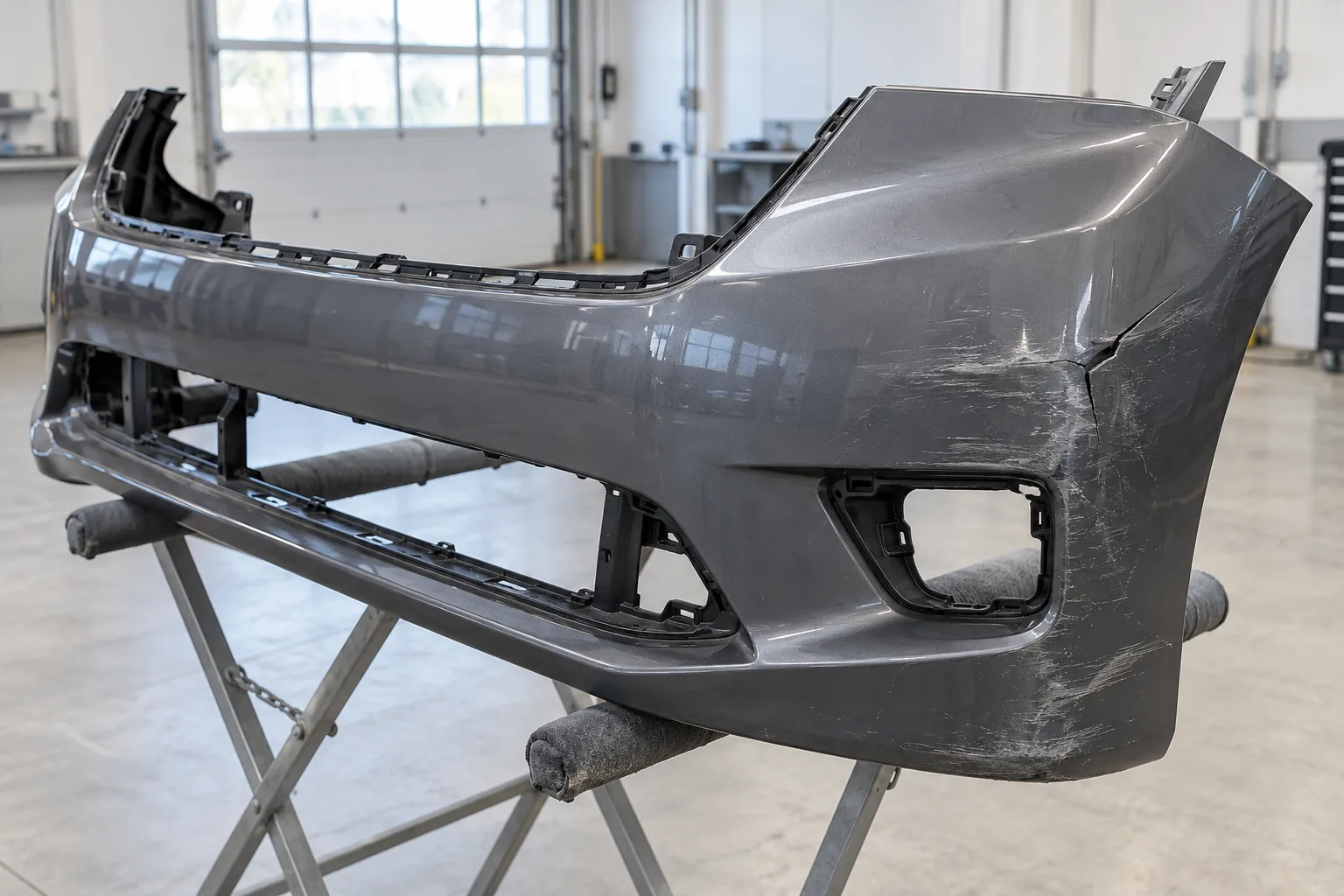
1. The bumper cover is only part of the assessment
Establish whether the quote concerns the outer cover, its mounts or components behind it too. Ask for guides, absorber, reinforcement beam and fittings to be listed separately where inspection is needed. A tidy repaired cover does not answer questions about the other parts.
Before choosing a method, ask about the material and previous repairs. Tesla’s plastic component instructions require identifying the material from its marking. This illustrates a manufacturer’s approach; it does not mean every cover can be welded or bonded.
2. Scratch, crack or mount: questions for the inspection
Use this table to structure a workshop discussion, rather than to approve a repair remotely. Record what is visible separately from what still needs checking.
| Visible sign | What needs establishing? | Question to ask |
|---|---|---|
| Scuff or scratch | Extent of coating and plastic damage | Is coating work enough, or does the substrate need repair? |
| Crack through the plastic | Both sides of the cover and damage location | Does the current procedure permit repair at this location? |
| Broken tab or uneven gap | Mounts, guides and fit | Which part is damaged, and what supports the proposed method? |
| Dent or missing section | Shape, missing material and components behind the cover | What needs inspecting after removal before the final quote? |
| Damage near a sensor or radar | Vehicle equipment and OEM zone boundaries | Are repairs prohibited or refinishing restricted in this area? |
| Signs of an earlier repair | Coating and plastic repair history | Can compliance with the current manufacturer requirements be established? |
3. Check technical permission before comparing prices
3M distinguishes minor surface damage from cracks through the plastic, which need a different procedure. This does not establish a universal repairable crack length.
An OEM example: Tesla’s front fascia instructions distinguish vehicles with and without radar. For radar-equipped vehicles, repairs in the radar area are prohibited. Do not apply this example to every model or bumper.
3M also highlights OEM coating thickness and material requirements near radar. Ask which checks and any calibration procedure apply after the proposed work; do not assume one requirement covers every car.
4. How do you compare repair and replacement costs?
First exclude any technically prohibited option. Then ask for two quotes covering the same finished scope: part or plastic repair, removal and refitting, preparation and paint, fittings and required checks. Comparing a used cover’s purchase price with a complete repair service is misleading.
For replacement, ask about the part number and source, equipment compatibility, mount condition and fittings transferred from the old cover. For repair, ask about the method and why it is permitted. For both, establish the gross total, exclusions and approval process for extra work. Without this information, a price for your car would be unreliable; this guide is not a price list.
5. Checklist before ordering work or settling a claim
In Poland, OC is compulsory third-party liability insurance, AC is voluntary own-vehicle cover, and OWU means the general insurance terms. For AC, check the particular contract. A workshop quote does not automatically confirm that an insurer will cover it.
- Prepare the make, model, year, incident description and photos of the whole bumper and details.
- Disclose known previous repairs and vehicle system warnings.
- Ask for recorded inspection findings, unresolved questions and the basis for the chosen method.
- If removal is needed, agree its scope and how further damage will be documented.
- Before ordering work, compare the written scope with the claim estimate and clarify differences.
- At collection, ask for the work description and results of required checks.
Next step: ask about a bumper assessment
Ask Glossline about an inspection and the scope of a quote. Agree how to provide photos and vehicle details. Separate visible damage from questions that require the part to be checked.
Scope of this guide
This is general information, not a decision on a specific claim. The right next step depends on the documents, damage and insurer’s position.
Sources and further reading
Technical sources are in English; PZU’s insurance definitions are in Polish. Tesla instructions illustrate OEM restrictions, not rules for every make or confirmation that Glossline services these models. Check the current procedure for your vehicle. Accessed 24 October 2026.
- 3M: Cosmetic Flexible Bumper Repair (accessed 24 October 2026)
- 3M: Meeting OEM Requirements for Paint and radar areas (accessed 24 October 2026)
- Tesla Model 3: Plastic Component Repair Guidelines (accessed 24 October 2026)
- Tesla: Front Bumper Fascia Repair Guidelines, model table and radar area (accessed 24 October 2026)
- PZU: OC, AC and OWU definitions (27 November 2024; accessed 24 October 2026)