Why is the paint code only a starting point?
A code identifies the original colour, but variants may exist within it. Previous repairs, weathering and application also affect appearance. Metallic and pearl finishes look different as the viewing angle changes. The same formula number does not promise identical appearance on two surfaces.
Colour matching and blending work together. AkzoNobel bulletin AN24.01 explains that tinting a formula does not always remove the need to blend. Equally, a large colour difference calls for correction of the match: simply extending the blend cannot disguise any degree of mismatch.
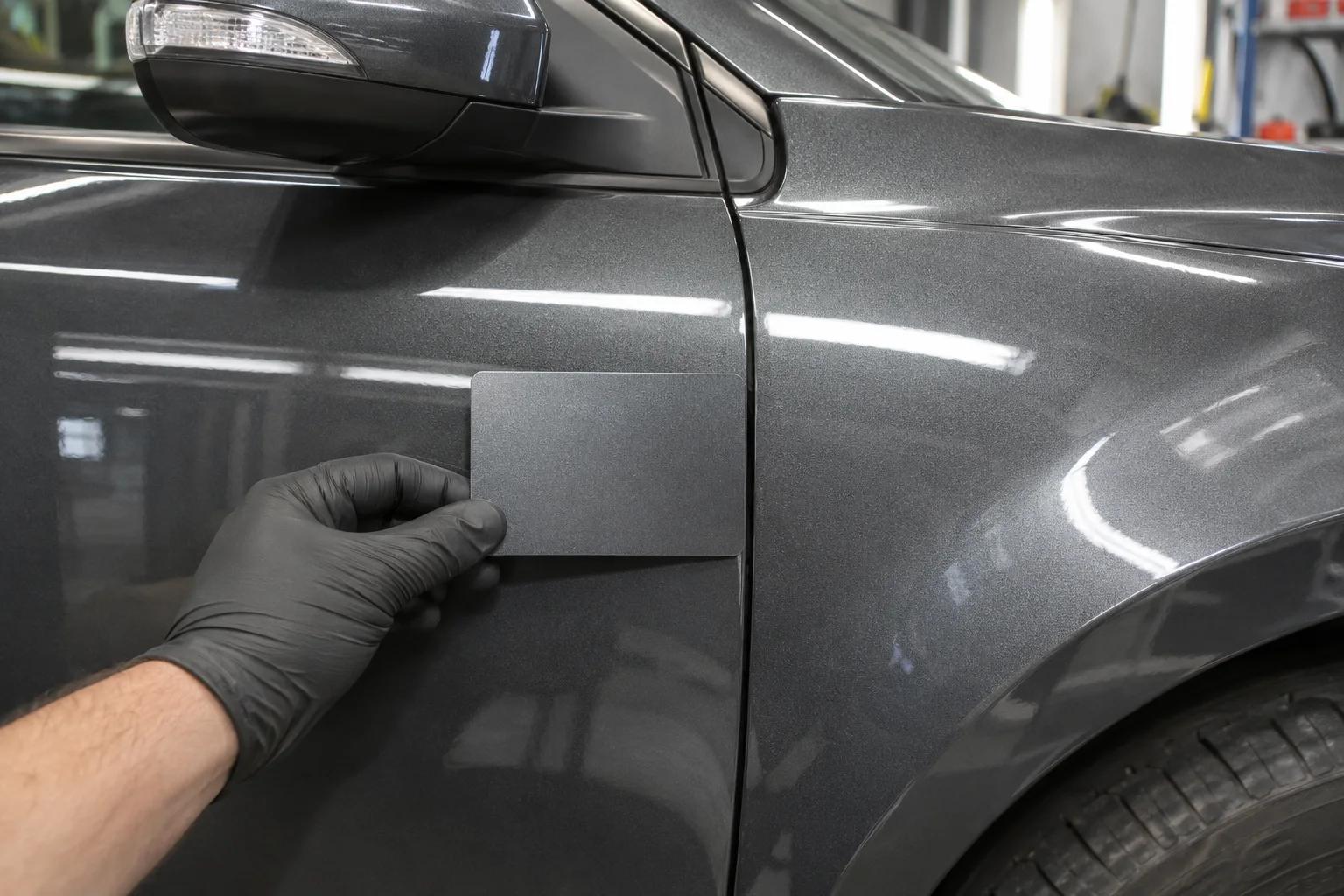
What does a spray-out card establish?
A spray-out is a coated test card used to compare the prepared colour with the car before painting the body. It should represent the intended coating layers and finish. Sherwin-Williams' practices for its system call for a sample with the appropriate clearcoat, compared in sunlight or colour-corrected light, both head-on and at an angle.
For three-stage colours, a stepped let-down panel helps establish how the number of mid-coats affects appearance. PPG also describes the importance of undercoat colour for translucent finishes. These are reasons to ask how the colour was checked rather than expect a phone photograph to settle the match. Details must follow the current data sheet for the selected system.
When might blending extend into the next panel?
What matters is the space between the preparation or primer area and the panel edge, rather than just the scratch length. If colour reaches a joint with an undamaged panel, or covers an entire replacement part, there may be insufficient room to fade it within that part. BASF describes this planning approach in its fundamental refinishing guidance.
There is no single distance suitable for every colour, shape and system. Sometimes the colour blend can stay within the repaired panel; that does not make any clearcoat stopping point acceptable. Matt, satin, multi-stage pearl and parts subject to OEM restrictions require the relevant procedure. The label 'metallic' alone does not determine the panel count.
Basecoat blending and clearcoat boundaries are different
Basecoat provides colour; clearcoat is a separate finishing and protective layer. Colour may fade across only part of the neighbouring panel while clearcoat covers a larger area. An estimate saying 'blend door' therefore does not fully describe which layers and areas will be coated.
For example, PPG procedure PD-0730 requires clearcoat to reach a panel edge or break point for the stated warranty conditions. AkzoNobel AN24.01 recommends clearcoating the entire repaired panel even when colour is blended. These illustrate manufacturers' rules; they do not establish which products Glossline uses or a warranty for a particular repair. Ask for the boundaries of both layers on your car.
Table: questions before approving the scope
Use this table to discuss the process. It does not select a repair method from a photograph.
| Situation | What needs explaining | Question before approval |
|---|---|---|
| Colour reaches a panel edge | Room for a gradual transition | Why cannot the blend stay within this panel? |
| A new or fully colour-coated panel | Matching adjacent surfaces | What was the spray-out compared with? |
| Pearl or translucent colour | Layer structure and undercoat influence | Were the variant and a let-down sample checked? |
| Undamaged neighbouring panel | Separate basecoat and clearcoat boundaries | Exactly what will be prepared and coated? |
| Matt or another special finish | A procedure for that coating | How will the gloss level be matched and checked? |
What should the estimate make clear?
Ask for the repaired panel and every blend panel to be named. Separate substrate repair from blend preparation, colour application, clearcoat and any necessary removal of fittings. This makes two estimates easier to compare without assuming 'painting' means the same operations. Agree additional scope and price before work is carried out.
- Which colour problem is the blend intended to solve?
- How was the colour checked, and which procedure informs the plan?
- Where will basecoat and clearcoat end on each panel?
- Which removal operations and materials are included?
- How will scope changes and handover observations be recorded?
How can you inspect the result at handover?
Inspect a clean, dry surface and panel transitions under comparable lighting. Look head-on and obliquely; where conditions allow, also compare the appearance outdoors. Consider shade, metallic effect, gloss and texture. One flash photograph cannot replace this inspection.
Describe any visible difference or boundary, identifying the panel and viewing conditions. Record it in the handover document and agree further assessment. Appearance alone cannot reliably identify the cause: colour selection, application or other coating features may be involved. Do not try to remove a colour mismatch by aggressive polishing.
Will insurance pay for blending in Poland?
In Poland, OC is compulsory motor third-party liability insurance; AC is voluntary own-damage cover. OWU means the general insurance terms and conditions. A technical reason for an operation does not itself confirm payment in an individual claim. Keep damage records and the proposed process description; establish funding through the relevant claim and, for AC, check your own policy and OWU. This guide does not predict an insurer's decision.
Scope of this guide
This is general information, not a decision on a specific claim. The right next step depends on the documents, damage and insurer’s position.