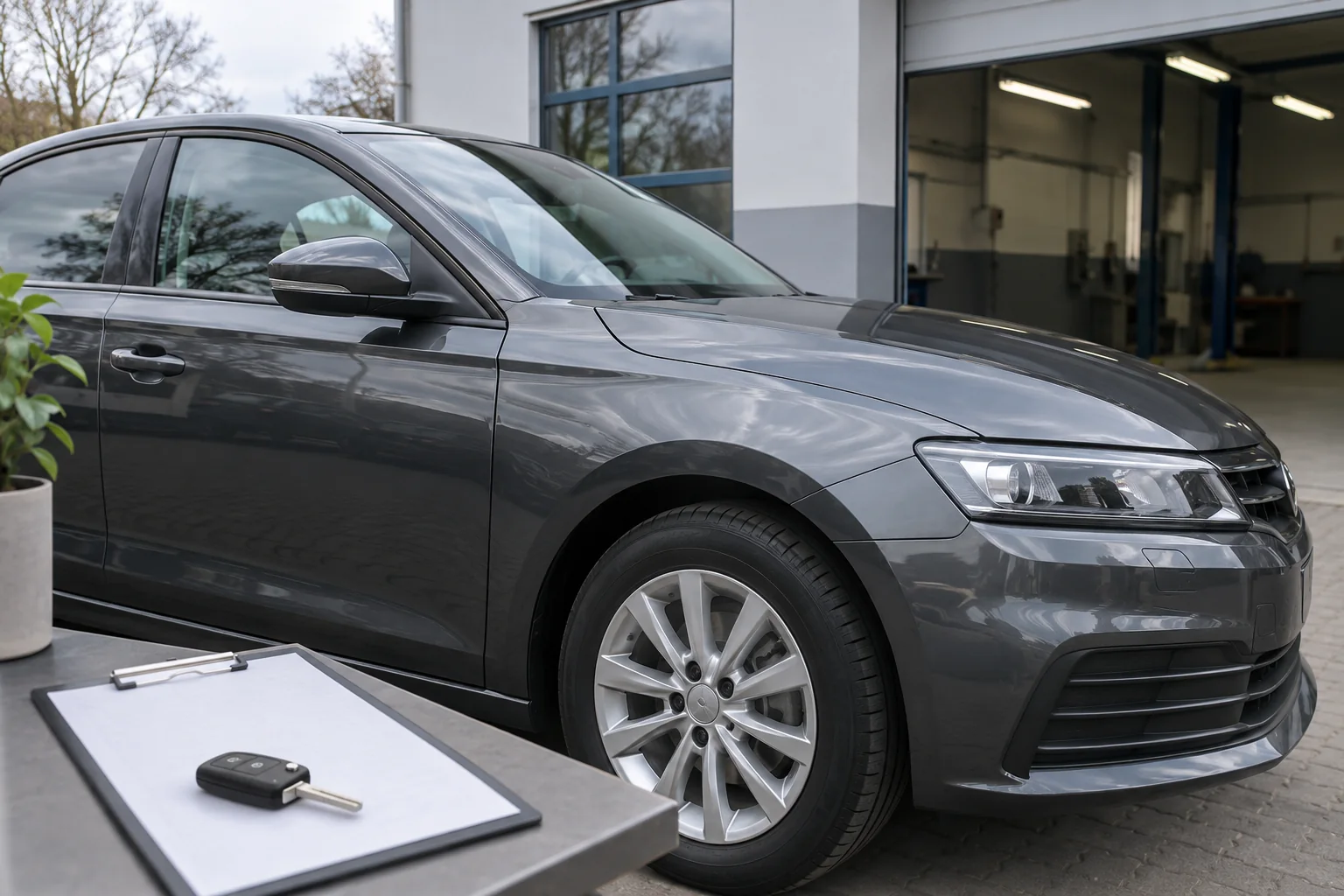
Start with the repair order and records
Bring the approved scope, subsequent approvals for extra work and the intake photos. Ask for an itemised record of the work, parts and materials, together with the billing document. Compare the repair with the order rather than just the final total. Record the date, mileage, fuel or charge level, and return of keys and equipment left with the vehicle.
In Poland, OC is compulsory motor third-party liability insurance. AC is voluntary cover for your own vehicle within the agreed scope; OWU are the policy's general terms and conditions. For an OC or AC claim, distinguish repair quality from payment: establish who pays any shortfall, excess or privately ordered work. An insurer's approval of an estimate does not replace checking the car.
How should you inspect paint and panel fit?
Ask for a clean, dry car and good lighting, ideally including daylight. View the repaired area and adjacent panels from several angles. Look at colour, gloss, texture, runs and visible inclusions. Check edges, seals, glass and trim for stray paint and masking residue.
A different reflection on a curved bumper and a flat fender does not by itself prove a colour error. PPG explains that substrate, application and shape affect colour appearance. Ask the repairer to assess a noticeable difference with you. Equally, a single universal paint-thickness reading cannot establish that an entire repair is correct.
Compare gaps and panel positioning. Carefully check the opening, closing and latching of repaired doors, bonnet or boot. Do not slam panels or adjust latches yourself. Loose trim, rubbing or difficulty latching needs an explanation.
Which functions can you check at the workshop?
With a staff member, check equipment removed or affected by the work: lights, indicators, handles, windows, mirrors, wipers, washers or camera image. Ask about dashboard messages and system limitations. Do not test automatic emergency braking or lane assistance by deliberately creating a hazardous situation.
If there are leaks, unusual braking, steering problems or a bonnet that will not latch, do not drive onto the road to see whether the issue clears. Arrange a technical check and safe transport if needed. Agree a road test only after safety concerns are resolved; it cannot replace required measurements.
Which results should a specialist provide?
Good appearance cannot confirm structural geometry, wheel alignment, joints hidden by trim or safety-system operation. Where the repair scope required such checks, ask for the result linked to the vehicle, date and operation: body measurement, wheel alignment, diagnostics or calibration.
ADAS means advanced driver assistance systems using equipment such as cameras and radar. Reading fault codes and calibrating a system are separate operations. Ask which current manufacturer procedure applies and whether it was completed successfully. Bumper repairs do not all require the same steps. For example, the Tesla Model 3 2024+ manual distinguishes alignment requirements by component and operation; it is not a procedure for every make.
A checklist to copy into the handover record
Add the date, vehicle details and repair-order number. Mark each check as yes, no or not applicable. A missing record or an unperformed test needs clarification; it is not automatic proof of a defect. Assign a responsible person and a contact date for each open item.
| Item | Checked | Concern | Agreed action |
|---|---|---|---|
| Work, parts and billing | … | … | … |
| Colour, surface and edges | … | … | … |
| Gaps, fixings and latches | … | … | … |
| Equipment affected by the repair | … | … | … |
| Required measurements, diagnostics and calibration | … | … | … |
| Care instructions, keys and equipment | … | … | … |
How do you record a concern at collection?
Describe the location and symptom, take an overview photo and a close-up, and ask for a joint check. Read the handover record before signing; do not confirm that you have no concerns if you are raising some. Keep a copy with the observations and agreed steps. If the repairer will not include them, send a written description and retain evidence of sending. The record alone does not establish the cause or responsibility.
Fictional example: after a left-door repair, the window stops while closing. Record 'front left door — window stops halfway' rather than 'bad repair'. Agree who will investigate and when, and whether the vehicle can be used safely. Do not assume that the window motor is the cause.
When can you wash or polish the car?
Ask for written instructions for the actual paint system: first wash, pressure washing, wax, polishing, coatings or film. There is no single waiting period suitable for every repair and finish. The product, drying process and finish type matter.
Matt finishes need separate instructions. For example, Standox for a particular textured matt Peugeot finish excludes polishing, wax and high-pressure washing. Do not apply these rules to all paint systems. Do not try to remove a suspected defect with compound before documenting it and having it assessed.
Does collection prevent a later complaint?
Report an issue discovered later to the repairer too: provide the date, mileage, conditions, symptoms and action you are requesting. Attach the order, photos and handover record. Under Polish law, liability for defective work and any additional guarantee need to be distinguished; available remedies depend on the contract and circumstances. Do not assume every workshop offers the same guarantee period.
For a consumer dispute, a municipal or district consumer ombudsman can help. An independent assessment may be useful for technical doubts. This guide is a general owner's checklist, not Glossline's handover policy or an individual technical or legal opinion.
Scope of this guide
This is general information, not a decision on a specific claim. The right next step depends on the documents, damage and insurer’s position.