What do O, Q and P mean in a repair estimate?
The definitions below come from Poland's financial regulator, KNF. Check which estimating system was used and read the key on your estimate. If you see an additional code such as PJ, PC or PT, ask whoever prepared the estimate to explain it and provide documentation for the exact part number.
| Code | KNF definition | What to check |
|---|---|---|
| O | New original part supplied by the vehicle manufacturer. | Part number and compatibility with the car's equipment. |
| Q | New part from the supplier that supplies that component for factory fitment. The parts maker certifies that it meets the vehicle maker's specifications and production standards. | Whether the certificate covers the exact part number. The supplier's brand alone is insufficient. |
| P | New non-original part of comparable quality. The parts maker provides a warranty and certifies that its quality matches the factory-fitted component. | The maker's certificate, warranty period and reason for selecting the part for this repair. |
How does the car's pre-accident condition affect an OC estimate?
OC is Poland's compulsory motor third-party liability insurance. For a claim under the other driver's OC, start with the car's condition before the damage. Photograph the number and markings on the damaged part if visible. Keep invoices for previous repairs and warranty paperwork. If you cannot see the label, ask the repair shop to photograph it during inspection or disassembly.
KNF Recommendation 18 calls for O parts where a current vehicle manufacturer warranty requires their exclusive use. The claimant's specific interest may also matter, for instance if records show exclusive use of O parts and a different category could affect the car's value. For P parts, the circumstances matter, including how worn the original component was and how simple its design is. If the estimate specifies a lower category than the damaged part, ask for a reason for that line item.
If the insurer lists a Q part in its estimate, ask it to show that the supplier provides that component to the vehicle maker and to confirm the exact part meets the maker’s specifications.
Why can similar-looking headlamps have different functions?
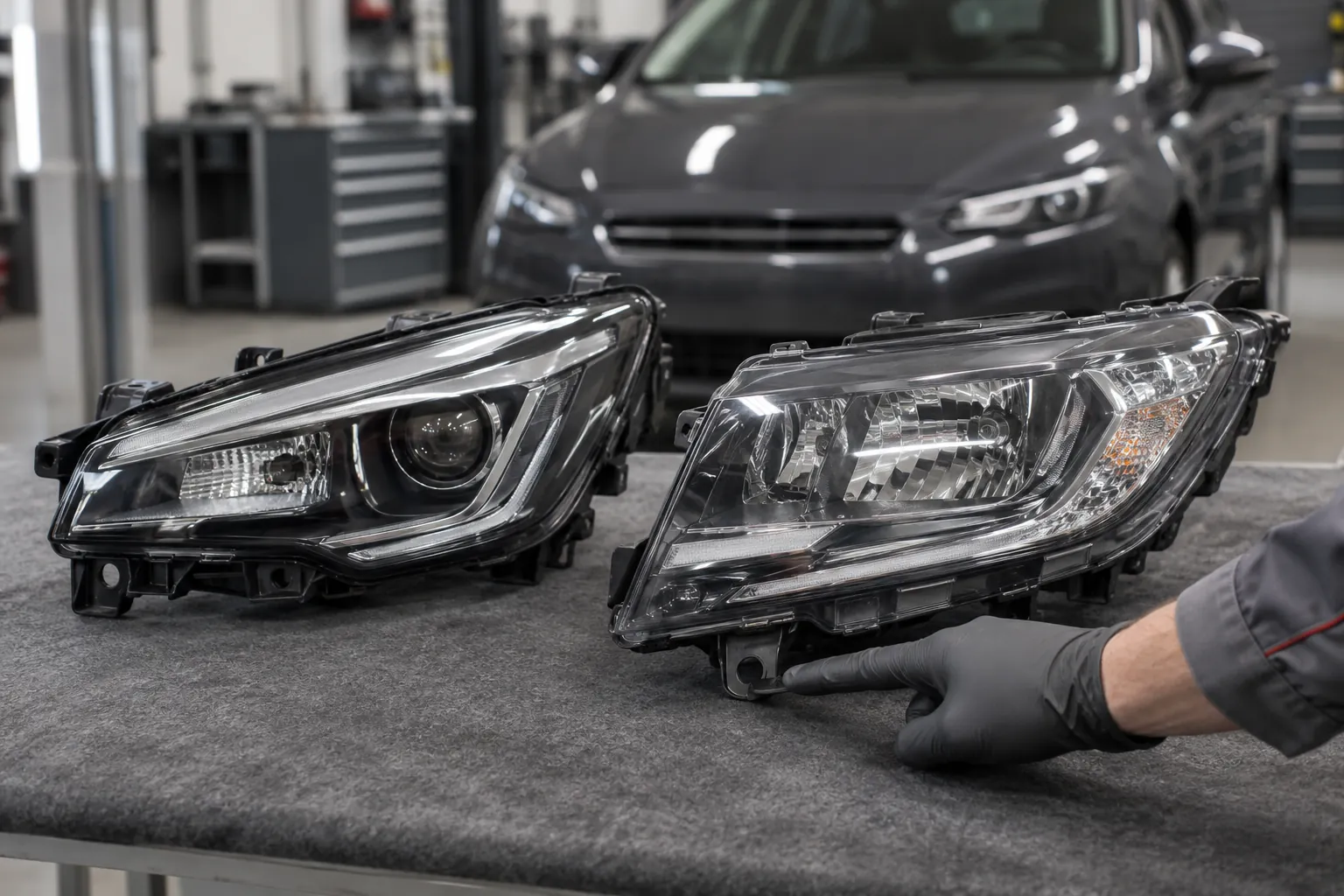
Suppose the damaged headlamp had cornering lights and the estimate lists a unit with a similar housing. Ask the shop to cross-check the part numbers against the VIN and confirm the side, lighting system and what comes in the kit. Find out whether the price includes the control unit and whether the vehicle maker calls for configuration or beam adjustment after fitting. If the quoted unit lacks cornering lights, record that difference against the relevant line item.
What changes if you claim under your own AC?
AC is voluntary comprehensive motor insurance. The policy and the option you chose govern how a claim is assessed. In the OWU (general terms and conditions of insurance), find the partial damage section and check how parts are valued, what deductions apply and whether the insurer requires invoices or a particular repair shop.
For example, § 11 of the PZU Auto terms for quotes from 21 March 2026 uses original-part prices for its service option and gives separate rules for the optimal option, which accounts for alternative-part prices. Check the edition of the terms that applies to your own policy.
What should you ask about a disputed part?
- What are the exact part number, maker and category? Ask for the key if the code is unclear.
- Who can supply the part at the stated price? Ask for a specific supplier and check stock.
- What confirms compatibility with my car's equipment, and what is included? Ask the shop to record its findings.
- What work is required after fitting, and does the estimate include it? Keep the reply with the photo of the old part and the supplier's quote.
Does the age of the car justify using P prices?
Vehicle age is one of the factors listed in KNF Recommendation 18. Ask how the insurer assessed the condition of the specific part and why the proposed replacement would restore its functions. Share records of previous repairs if they show what part was fitted.
Can an insurer quote a part that is unavailable?
Under KNF Recommendation 19, an estimate-based OC settlement should use parts that are available. If the named supplier cannot provide that part number at the quoted price, keep their reply and ask the insurer to identify an available part or recalculate the line item.
Does a used part count as P?
In the KNF glossary, O, Q and P are all categories of new parts. If an estimate lists a used or reconditioned part, ask the insurer to state its condition and explain the basis for the price. For an AC claim, check what your terms say about those parts.
Scope of this guide
This is general information, not a decision on a specific claim. The right next step depends on the documents, damage and insurer’s position.