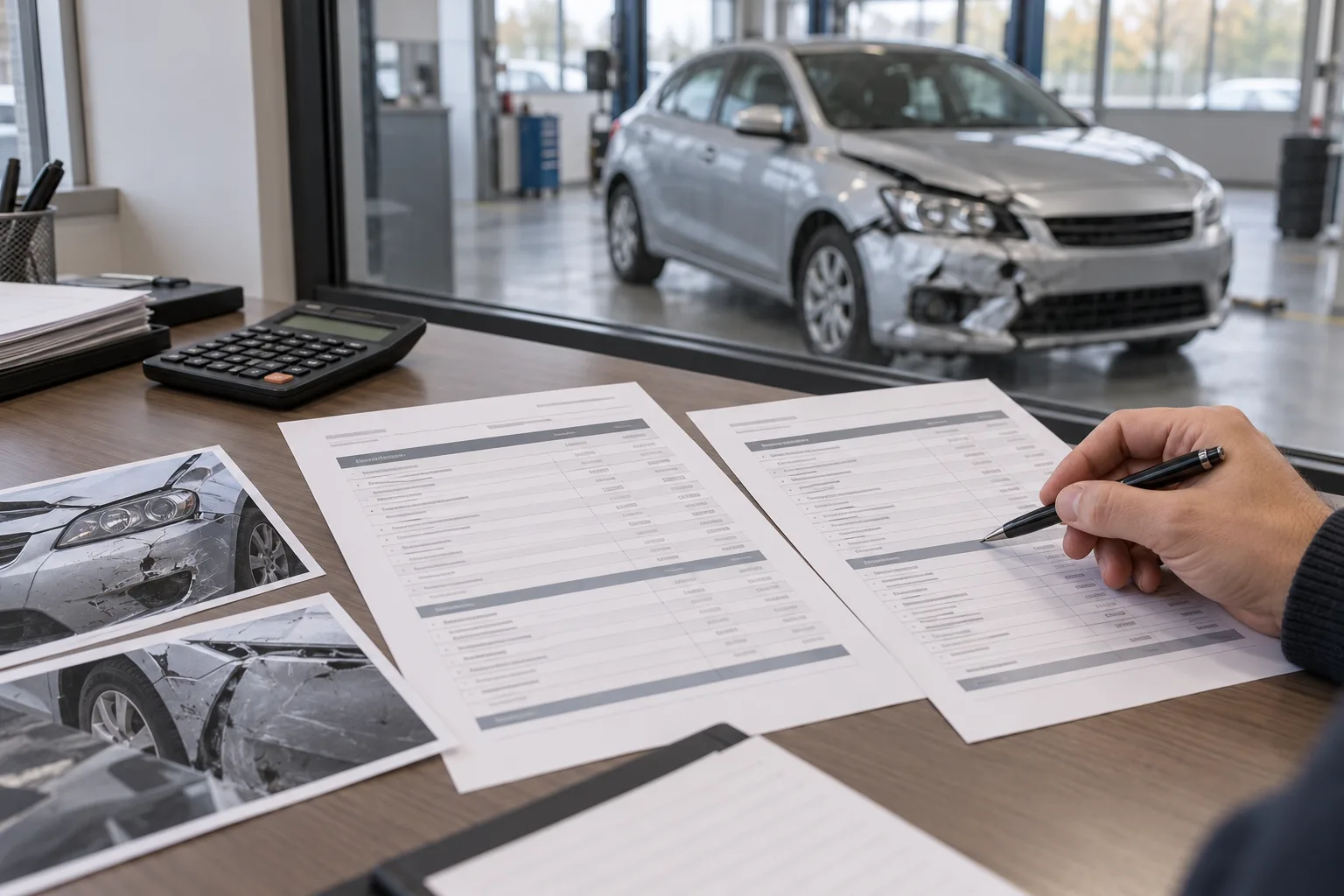
1. Collect the decision, estimate and timeline
This guide concerns partial vehicle damage in Poland claimed against the responsible driver’s OC, the compulsory motor liability insurance. AC is voluntary cover for your own vehicle; OWU are the policy’s general terms and conditions. For AC, check your contract and settlement option rather than automatically applying OC rules.
Create a folder containing the decision, every estimate version, photographs, inspection report, correspondence and repair records. Note the notification, decision and payment dates, and whether the vehicle is unrepaired, being repaired, repaired or sold. If you only have a total, request the full calculation and its assumptions.
The compensation sought needs to relate to the damage and its extent, rather than any chosen repair price. Articles 361–363 of Poland’s Civil Code provide the general framework. The table below organises evidence; it is not a valuation or an assessment of a particular vehicle.
2. Turn a general objection into specific differences
Number each difference and connect it to an attachment. Separate visible damage from a possibility that needs inspection. Do not present earlier damage as a consequence of this collision.
| What is disputed? | What should you attach? | What should you ask? |
|---|---|---|
| Missing component or operation | Photograph, inspection notes and item number | Why was it omitted, and is another inspection needed? |
| Repair rather than replacement | Damage description and vehicle-specific method justification | What supports this repair method? |
| Part or labour | Part specification, work scope and workshop calculation | Which part, hours and labour rate were used? |
| Paintwork and materials | Itemised preparation and painting scope | Which operations and materials does the amount cover? |
| Discounts or deductions | The actual offer and its availability conditions | What justifies the adjustment and access to the offer? |
| VAT | Settlement method and information on VAT deductibility | Why was net, gross or partial VAT used? |
| Damage found after dismantling | New photographs, discovery date and supplementary estimate | How should the additional evidence and inspection be arranged? |
3. State whether the vehicle is repaired or sold
Before repair, preserve evidence of the vehicle’s condition and a detailed estimate. After repair, add invoices, receipts, the work scope and photographs. After sale, keep the agreement, price and condition records. These are different factual situations; disclose later events.
The Ombudsman discusses differing approaches to estimates after repair or sale in its comments on III CZP 65/23 and the later III CZP 32/24 resolution. Do not assume a uniform dispute outcome. Individual legal advice may be needed on the applicable settlement basis.
4. Structure the complaint in six parts
The Ombudsman provides a form, but no single official template is compulsory. Be specific. This editorial checklist helps organise a complaint; it is not a completed submission for your case.
- Details: insurer, your contact details, claim number and vehicle identification.
- Subject: complaint about the decision or calculation, including its date and version.
- Request: explain the outcome sought; for an additional payment, specify the amount and calculation allowing for earlier payments.
- Reasons: numbered differences, facts and attachment references; separate technical and legal questions.
- Attachments: a list of identifiable files, photographs, estimates and receipts.
- Closing: request a response to each objection, add the date and sign where required by the submission method.
5. Keep proof of receipt and review the response
Use a complaints channel specified by the insurer. Keep the text, attachments and proof of receipt. For an individual customer, the Act requires a response without undue delay, within 30 days of receipt; sending it within that period suffices. In a particularly complex case, the maximum is 60 days from receipt, with reasons, outstanding issues and an expected response date explained (Articles 6–7).
These are complaint response periods, not a promise of payment or the limitation period for your claim. If rejected, check the reasons and information on further options (Articles 9–10). Before applying to the Polish Financial Ombudsman, submit a complaint and receive a response or wait for the response period to expire. Check eligibility for intervention or amicable proceedings; court action is a separate option. Do not assume waiting alone protects your claim deadlines.
Next step: prepare the records for comparison
Start with the decision, full estimate and photographs. Ask Glossline whether a technical comparison of the repair scope can be arranged; document sharing and the service scope need to be agreed. A technical assessment does not replace legal advice or determine entitlement to an additional payment.
Scope of this guide
This is general information, not a decision on a specific claim. The right next step depends on the documents, damage and insurer’s position.
Sources and further reading
These materials cover safety and insurance claim handling in Poland. They do not confirm the outcome of an individual claim or the scope of Glossline services. The original source materials are in Polish.
- Polish complaints Act: Articles 2–10 and 24 (consolidated 8 October 2026; accessed 20 October 2026)
- Polish Financial Ombudsman: complaint form and eligibility for help (3 September 2026)
- Financial Ombudsman: III CZP 65/23, repaired and sold vehicles (updated 11 March 2025)
- Financial Ombudsman: III CZP 32/24, estimates, VAT and discounts (24 September 2025)
- Polish Civil Code: Articles 361–363 (consolidated 16 October 2026; accessed 20 October 2026)