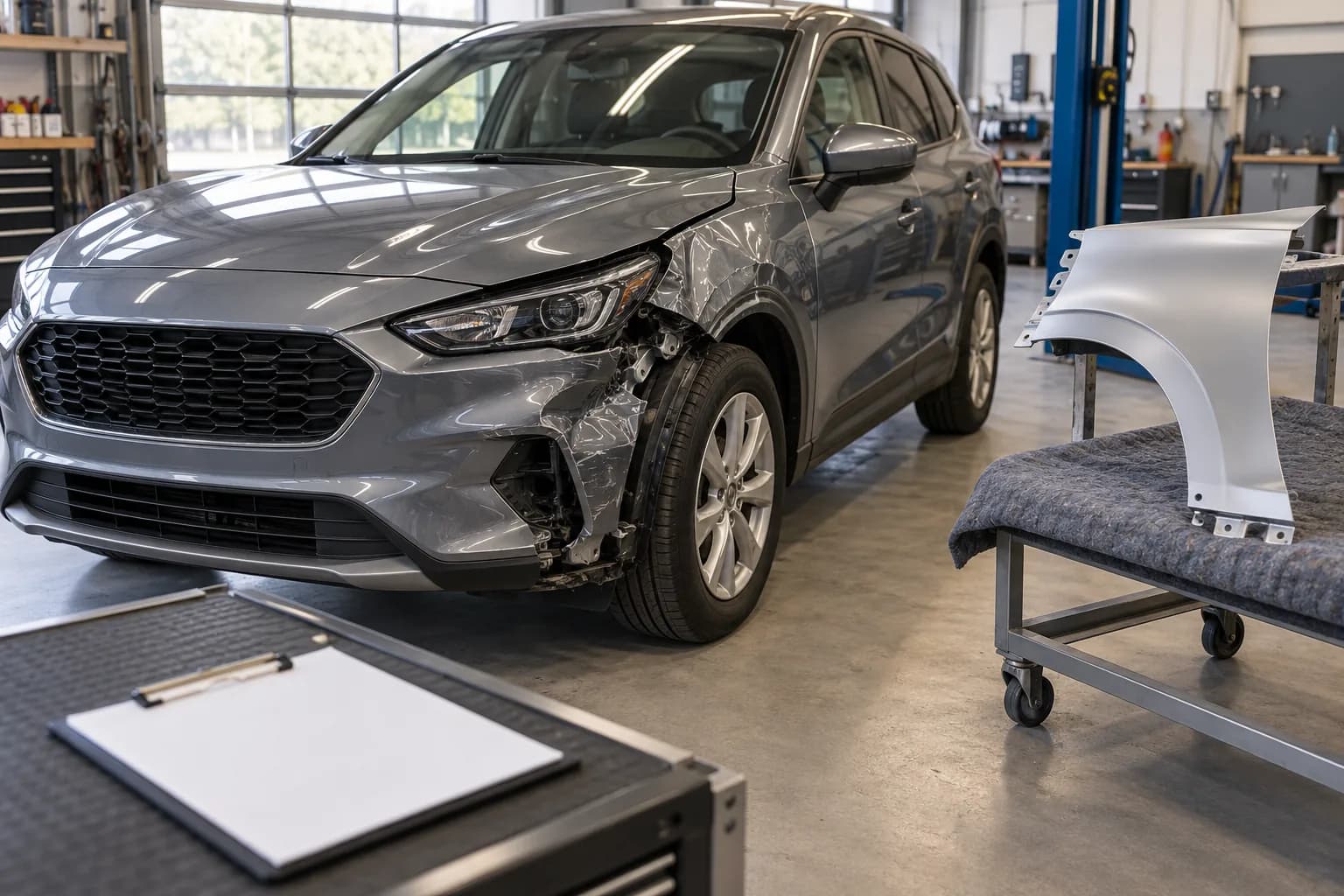
1. Separate labour time, downtime and payment
Record three separate periods: claim notification to the insurer’s position, workshop intake to collection, and the time needed for individual repair operations. They can overlap. Do not automatically add them together or convert labour hours into calendar days.
Ask where the quoted time starts: first contact, delivery of the car, confirmation of the scope, or receipt of all parts. Check whether the estimate uses working days. Two timelines with different starting points cannot be compared directly.
2. The stages to check before agreeing a collection date
Use this table to discuss a specific job. It is not a record of Glossline repair times. Some activities may overlap; ask which must finish before the next can begin.
| Stage | What does it depend on? | What should you request? |
|---|---|---|
| Inspection and records | Access to the car and extent of assessment | Inspection date, damage description and open questions |
| Dismantling and scope updates | Need to inspect parts behind outer panels | Photos of additional damage and a list of changes |
| Estimate and discussions | Repair order, payment arrangement and insurer’s position | What is confirmed, what is disputed and who responds |
| Parts and workshop booking | Confirmed deliveries and workshop availability | What is ordered, what has arrived and when work starts |
| Repair and painting | Procedure, preparation and material specifications | Current stage and remaining operations |
| Reassembly, checks and collection | Checks required after the work performed | Check results, completed scope and collection date |
3. Parts, hidden damage and process waiting times
Distinguish between a part being listed in a catalogue, ordered, confirmed for dispatch, and physically at the workshop. Ask which missing items prevent the next operation. Do not assume that either an aftermarket or an original part will always arrive faster.
If dismantling changes the scope, request a description of the difference, the date the supplement was sent and a revised plan. A change does not automatically mean the first inspection was wrong. Clarify who must authorise additional work and how.
Drying parameters belong to a specific coating system: PPG publishes them for D8173. Paint drying time alone is not the duration of the whole repair. Ask about preparation, subsequent operations and process conditions instead of asking for them to be shortened to an arbitrary deadline.
4. Does the OC 30-day rule mean the car must be ready?
No. Article 14 of Poland’s compulsory insurance Act concerns compensation payment: normally 30 days after claim notification. If necessary facts cannot be established then, payment is due within 14 days of when due diligence would have made this possible, generally within 90 days of notification. The Act contains an exception involving criminal or civil proceedings.
Within 30 days, the insurer must pay the undisputed portion and explain in writing why full payment is not possible and when it expects to take its position. This is not a statutory workshop collection deadline. When there is a delay, ask about payment separately from repair progress.
In Poland, OC means compulsory third-party liability insurance, AC means voluntary cover for your own car, and OWU means the general insurance terms. For AC, check your particular contract and OWU; do not automatically apply OC’s 90-day limit. The Financial Ombudsman explains the different legal bases.
5. A checklist for a useful schedule update
Instead of asking only “when will it be ready?”, request a dated status update. Keep the repair order, delivery confirmations, photos and correspondence. Suggested questions:
- Which parts of the scope are confirmed and what still needs inspection?
- What blocks the next stage and who takes the next action?
- Which parts have arrived and which have only an estimated delivery date?
- Is the collection date confirmed or conditional, and what are its conditions?
- When will I receive another update, even if nothing has changed?
- Which checks and documents remain before collection?
6. Why final checks also need a place in the schedule
Tesla’s Post-Repair Operations lists finishing tasks that may be needed depending on the repair. It is an OEM example for a particular model family, not a mandatory list for every car. Ask which checks apply to your vehicle and the work performed.
Before collection, agree how the completed scope will be documented and any outstanding items explained. A painted panel alone does not establish that the whole job is complete. Leave detailed technical assessment to someone inspecting the car.
Can intake wait until the parts arrive?
Ask whether this is possible if the car is safe to use. Do not judge safety from a photo alone. Agree the inspection, records and intake conditions first, including what could change after dismantling. This arrangement is not suitable for every type of damage.
What if the agreed collection date has passed?
Ask in writing for the cause, current stage, remaining actions and the next update date. If the issue concerns the insurer, separately request its position on payment. Keep a dated record; a missed forecast alone does not determine liability or reimbursement of every expense.
Next step: ask about the repair scope and schedule
Prepare the car model, damage description, photos and claim number if available. Ask Glossline about an inspection and what is needed to plan the repair. Agree how to send documents when making contact.
Scope of this guide
This is general information, not a decision on a specific claim. The right next step depends on the documents, damage and insurer’s position.
Sources and further reading
Polish legal and insurance sources, with PPG and Tesla materials in English. The OEM procedure and paint product are examples, not universal instructions or evidence of Glossline equipment. Checked on 29 October 2026. General guidance without an assessment of an individual claim.
- Polish compulsory insurance Act, Article 14; text dated 28 July 2026
- Polish Financial Ombudsman: claim settlement deadlines, June 2022
- PPG D8173: product-specific drying parameters; accessed 29 October 2026
- Tesla 2024+ Model 3: Post-Repair Operations; accessed 29 October 2026
- PZU: OC, AC and OWU explained; 27 November 2024